A recent pilot project conducted by Warner Music Group, GZ, and Abbey Road examined whether unsold obsolete records could be recycled and reintroduced into vinyl production while maintaining the high audio quality expected of commercial releases.
Evaluating the reuse of obsolete records in new pressings by: Madeleine Smith, Sr. ESG Director (WMG), Miriam Lessar, VP, Global Release Management (WMG), and Vladimír Víšek, Head of Sustainability (GZ).
Unsold inventory and obsolete records represent a material stream that has historically been difficult to reintegrate into production. Responsibly reintroducing these records into manufacturing can reduce the demand for virgin PVC plastics in pressing plants, resulting in demonstrable carbon savings. To reflect a realistic supply chain scenario, the pilot used mixed-origin pre-consumer vinyl records recovered from warehouse inventory – originating from various pressing plants, production runs, and compound formulations.
The project was designed around three core objectives:
first, ensuring that the recovered material would not compromise the sound quality listeners expect from vinyl;
second, assessing whether such approaches could be compatible with existing manufacturing systems and remain operationally viable at scale;
and third, evaluating the environmental implications of recycling pathways using product carbon footprint data and lifecycle assessment principles.
Within the conditions tested, the results of this study demonstrate that adding mixed recycled material from different sources has little effect on detectable differences in audio quality.
Designing the pilot To reduce production variability and ensure compliance with current standards, certain materials were excluded: smaller formats (7” and 10”), picture discs with layered structures, and records made before EU regulatory changes on vinyl stabilizers. Colored, glitter, and metallic vinyl were also excluded due to pigment mixing during pressing.
Following this pre-selection, approximately 10,000 records, originating from different pressing plants and stored by Warner Music Group at a warehouse in Europe, were transported to GZ’s pressing facility in the Czech Republic, where they underwent screening for material suitability before recycling began. Material samples were tested to assess whether recovered vinyl feedstock would remain stable at further pressing process. Records that failed thermostatic testing were excluded. The resulting feedstock consisted of three black vinyl titles from different pressing plants.
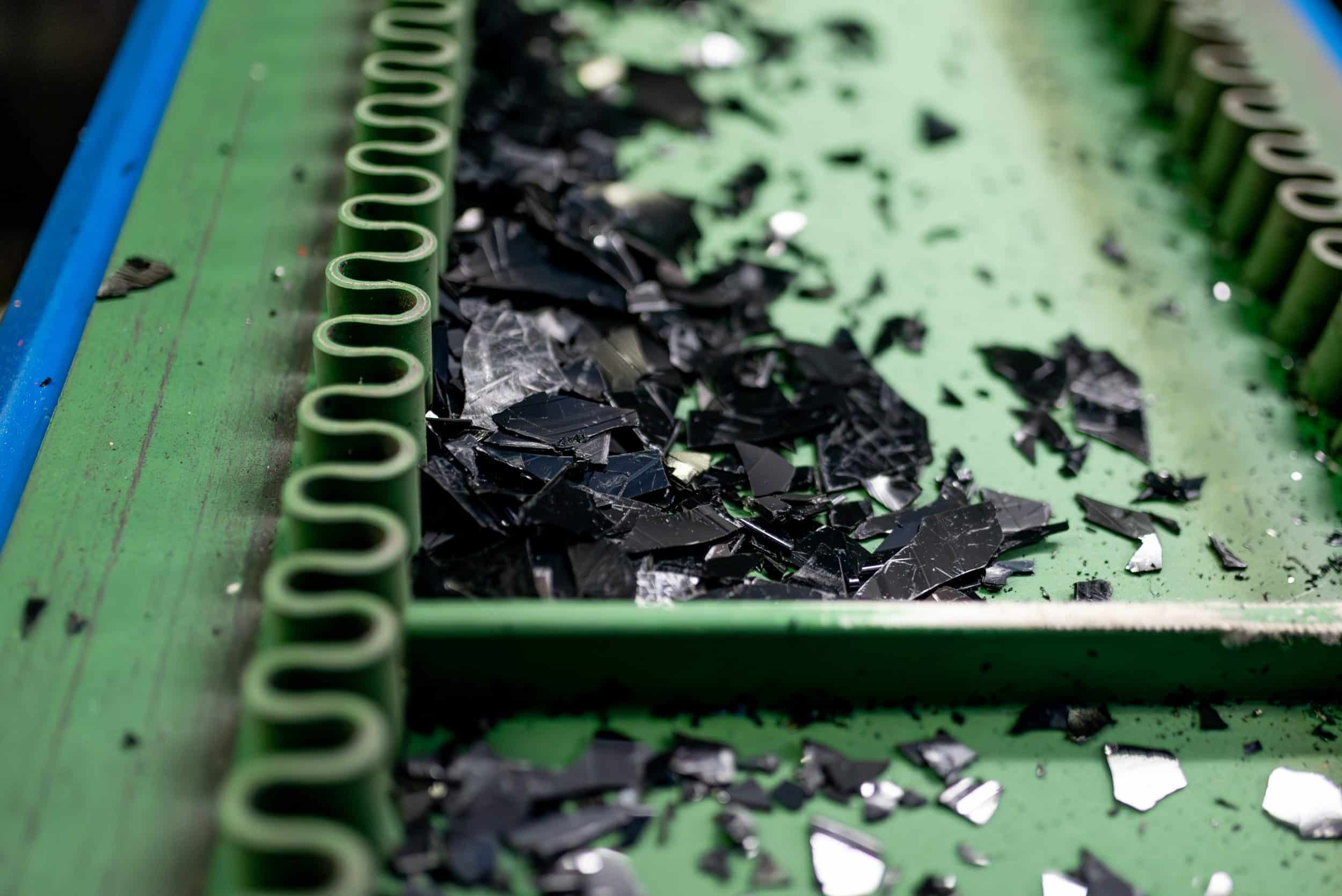
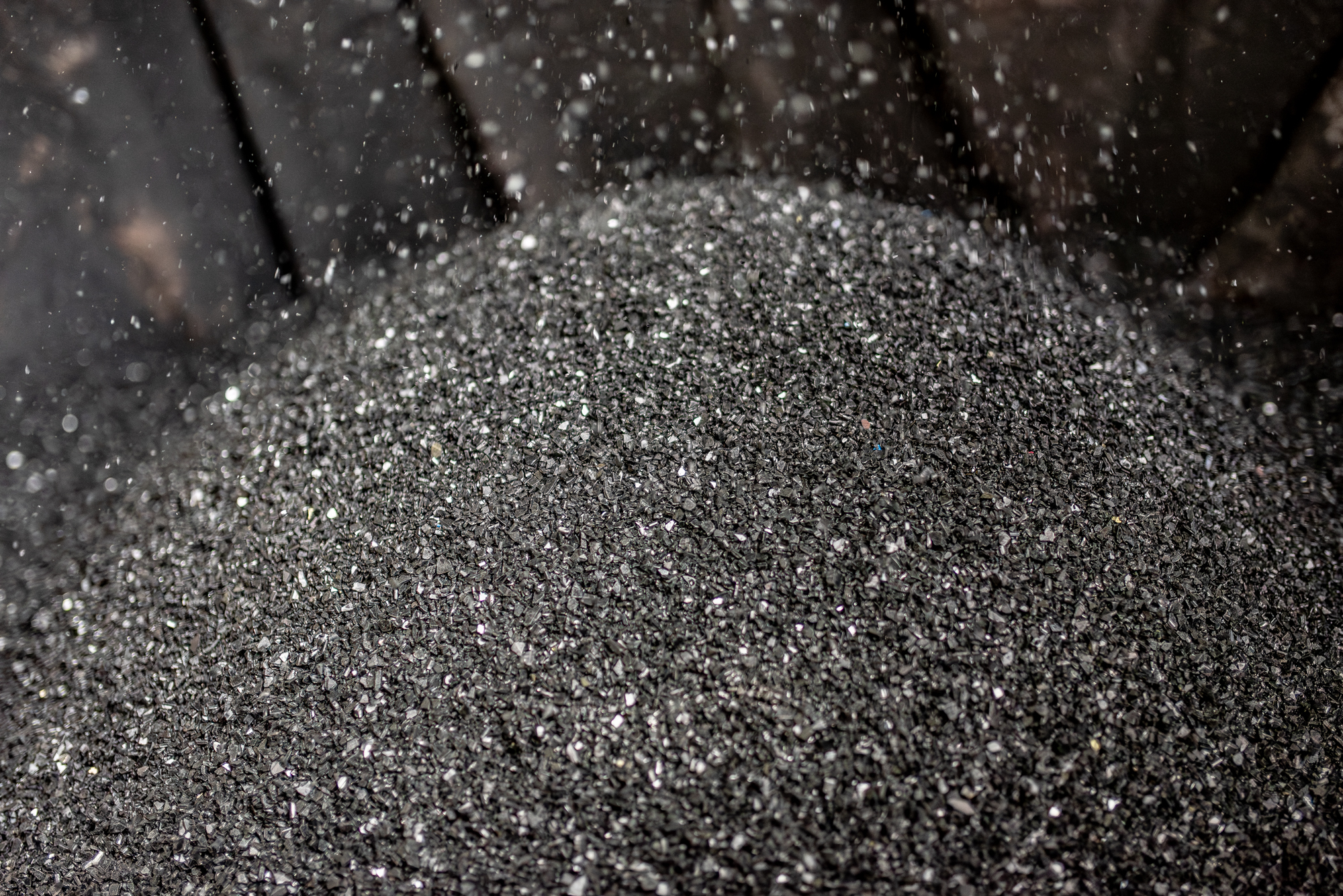
Once sorted and inspected, the records were mechanically shredded and micronized into fine vinyl particles. Multiple pressing variants were produced using different recycled content ratios, ranging from 10–100%. These included blends of mixed-origin pre-consumer recycled content and virgin compound, as well as a control pressing produced entirely from virgin material.
The pressing trials were conducted in two rounds to iteratively evaluate the performance of the recycled material. The second round repeated the initial test conditions while introducing additional variants, including one produced on an automated press. This approach allowed the project team to refine the methodology based on observations from the first round and to further assess how mixed-origin vinyl material behaves during pressing across different blend compositions.
To ensure consistency, all test record variants were produced using the same metalwork and press, with the exception of the automatic press version.
Blind testing of sound quality Because audio performance remains the central concern for vinyl manufacturing, the project placed significant emphasis on listening evaluation. A dedicated test record was produced for the pilot with lacquers cut at Abbey Road Studios. The program material was selected to represent two different listening conditions commonly encountered in vinyl releases.
One side featured material representative of recordings with a wide dynamic range and extended quiet passages, where low-level surface noise, background noise, or pressing artifacts are more easily revealed. The other side reflected a more typical modern mastering profile, with higher average levels, greater compression, and a denser overall sound, where defects may be less immediately perceptible but still impact overall clarity and consistency.
To reduce bias during evaluation, the pressings were anonymized using coded identifiers before they were distributed to the listening panel.
Listening results The listening evaluation involved seven global experts across Warner Music Group, GZ, and Abbey Road Studios. Participants assessed each pressing independently using a structured checklist commonly applied during test pressing reviews. The checklist was designed specifically for these listening tests, developed in collaboration and with input from all listeners, ensuring that the criteria was appropriately detailed and rigorous to evaluate the audio quality of each mix.
The listening and inspection criteria included surface noise, distortion, dynamic response, overall listening quality, and other audio and visual indicators of pressing performance. Two listening rounds were conducted. In Round 1, evaluation was based solely on physical records. In Round 2, evaluators assessed standardized digital rips of the test records, prepared by Miles Showell at Abbey Road, while also providing the corresponding physical discs for reference.
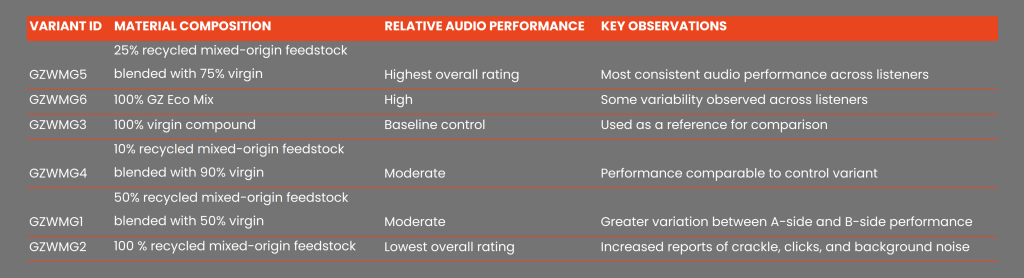
The pilot successfully produced pressings suitable for commercial release, with evaluators noting only minor differences in audio performance across all variants tested, indicating comparable listening quality. Across the listening panel, blends incorporating mixed-origin recycled feed stock produced no consistently detectable differences in sound quality. The three highest-rated variants fell within a narrow range of roughly 0.2 points on a ten-point scale, and all assessed variants ranged only 0.5 points between the best and the worst, suggesting that recycled blends can perform comparably to virgin vinyl pressings. Overall, the listening panel did not identify evidence suggesting that recycled mixed-origin feedstock inherently compromises perceived audio quality under the conditions of this pilot.
“Vinyl listeners care deeply about sound quality, so the standards for this project were always high. What impressed me was how consistent the pressings were across the different material blends, showing that sustainability and sound quality do not have to be at odds.”
Miles Showell, Mastering Engineer, Abbey Road Studios
Observations from the pressing floor Vinyl manufacturing requires precise control over compound properties and pressing parameters. During the initial trials, operators observed that blends with higher recycled content from different sources required additional adjustment to maintain consistent puck size and weight. This behavior appears linked to the mixed-origin nature of the recycled feedstock.
Because the obsolete records originated from multiple pressing plants using different compound formulations, the recycled compound contained a mixture of stabilizers and additives. This variability can influence melt behavior during pressing, making the material more difficult to stabilize at higher recycled content levels.
During the pilot, good-quality records were produced across all variants tested. However, blends containing higher proportions of mixed-origin pre-consumer material (50% and 100%) were more difficult to produce. They required greater operational adjustment, produced more waste during the production, and needed more focus from the operators. Lower recycled-content blends (10% and 25%) containing mixed-origin pre-consumer material behaved more consistently during pressing.
In practice, these observations suggest that incorporating mixed-origin preconsumer vinyl inputs into standard production processes may support efforts to recover obsolete records while maintaining consistent product quality. As segregating and tracking the recycled material throughout the whole production is not effective and can cause the issues described above, a mass balance approach at the plant level is suggested as the best way to use all the obsolete record material, minimize operational issues, and produce records of the expected quality. In this way, the material is mixed with regular production in lower ratios and is fully accounted for rather than physically tracked throughout the whole process (the same approach as in ISCC Plus bio-attributed compound).
This approach prevents declaring that a finished record physically contains a certain percentage of recycled material; however, it guarantees that the obsolete record material was used as efficiently as possible.
By contrast, the homogeneous recycled compound Eco Mix, produced from internal manufacturing scrap, was easy to press and did not present the challenges observed with the mixed-origin pre-consumer material. Eco Mix ranked among the top-performing variants, demonstrating that recycling controlled production waste does not compromise record quality.
Evaluating environmental implications Alongside the technical testing, the project initiated an environmental assessment to examine the lifecycle implications of recycling obsolete vinyl records. With support from ClimatePartner, the analysis applied life-cycle assessment principles aligned with the Greenhouse Gas Protocol Product Life Cycle Accounting and Reporting Standard.
Recycling mixed-origin pre-consumer records reduces demand for virgin PVC but introduces additional processes, including transportation, warehousing, sorting, and mechanical shredding. The environmental analysis therefore aimed to determine whether incorporating mixed-origin pre-consumer recycled material yields a net environmental benefit once these additional processes are taken into account.
To evaluate the environmental impacts of this project, two scenarios were modeled. Both involved the production of 1,000 newly pressed records: Scenario 1 used 100% mixed-origin pre-consumer recycled vinyl feedstock, while Scenario 2 used 100% virgin PVC. In both scenarios, emissions associated with storing obsolete records at a contracted warehouse in France for one year were included.
The records were then either transported to GZ’s for recycling (Scenario 1) or sent for disposal (Scenario 2). The quantity of obsolete records modeled corresponded to the material required to press 1,000 new records. Because the pre-consumer vinyl never reached an end consumer, its lifecycle was treated as extended through reprocessing in manufacturing, rather than the production of new records from virgin PVC.
As part of this extended lifecycle, the emissions associated with each obsolete record’s original production are included in the analysis. These are estimated using an average emission factor of 0.75 kg CO2e per record for European production, as reported by the Vinyl Alliance and Music Climate Pact’s Sustainable Supplier Programme Report (2025), and are applied consistently across both scenarios.
Rather than calculating the product carbon footprint (PCF) of a single record, the analysis applied a mass-balance comparison across two scenarios in which 1,000 new records were produced. This ensured that the same preconsumer obsolete inventory existed in both scenarios, regardless of whether it was recycled into new production or disposed of. As a result, the outputs of this pilot are not directly comparable with previously published vinyl product carbon footprints.
In this exercise, Scenario 1 resulted in 10.6% lower carbon emissions than Scenario 2. This reduction is primarily driven by lower demand for virgin raw materials and a smaller volume of material reaching disposal. These benefits are partially counterbalanced by emissions associated with collecting, storing, transporting, and processing the obsolete records. Even after accounting for these additional processes, incorporating pre-consumer recycled vinyl results in lower overall emissions than producing records entirely from virgin materials.
What this study contributes This pilot set out to test a simple but important question: can obsolete vinyl be recycled into new vinyl without compromising what listeners care about most. Under controlled, standard manufacturing conditions, using a carefully screened set of pre-consumer material, the findings point to a credible path forward.
At its core, the takeaway is simple: vinyl-to-vinyl recycling can work. Even heterogeneous, mixed-origin vinyl material can be reintroduced into the pressing process without compromising the listening experience, alongside more controlled internal streams such as waste occurring during the production (e.g., Eco Mix).
This pilot, led by Warner Music Group and GZ, represents an early proof point for circular vinyl production at scale. It challenges the long-standing assumption that recycled inputs come at the expense of sound quality, and instead shows a credible path where both can be achieved.
Future work will expand this research across a wider range of materials, production environments, and manufacturing systems.
Readers interested in the full methodology and technical analysis can access the complete report on the link below.